
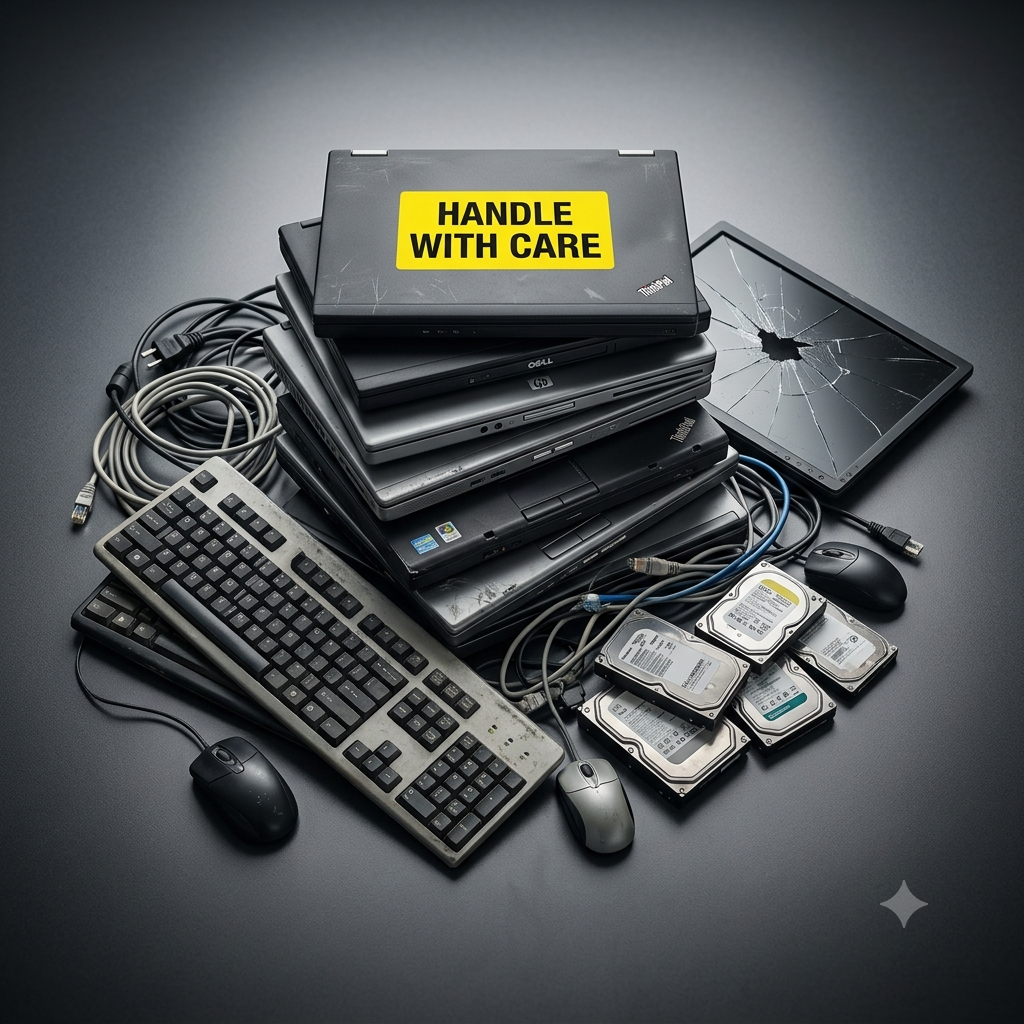
Your company just upgraded 50 laptops. The old ones are sitting in a storeroom. Your IT team is asking what to do with them. Someone suggests giving them to the kabadiwala. Another says just throw them out.
Both options are wrong — and under Indian law, both could expose your company to serious legal liability.
This is the reality of IT Asset Disposal (ITAD) in India — a subject most companies ignore until it becomes a problem. Here is everything your business needs to know.
Key Takeaways
- Under E-Waste Management Rules 2022, all companies are legally responsible for disposing IT assets through authorized channels only.
- Giving old devices to kabadiwalas or throwing in regular trash is a violation — penalties apply.
- Data on disposed devices must be permanently destroyed — a data breach from an improperly disposed device is your company's liability.
- CPCB-authorized recyclers provide legal documentation to prove compliant disposal.
- Bulk pickup is free — there is no cost to dispose IT assets the right way.
What is IT Asset Disposal (ITAD)?
IT Asset Disposal — or ITAD — refers to the process of retiring old technology equipment from an organization in a way that is secure, compliant, and environmentally responsible.
This includes laptops, desktops, servers, monitors, printers, networking equipment, mobile phones, tablets, UPS systems, hard drives, and any other electronic device used in a business setting.
ITAD is not just about throwing things away. It involves three critical steps:
- Data destruction — ensuring sensitive company and client data cannot be recovered from disposed devices
- Legal compliance — disposing through channels authorized under India's E-Waste Rules
- Environmental responsibility — ensuring materials are recycled, not landfilled
Most Indian companies handle only one of these three — and inadequately at that.
What Does Indian Law Say?
India's E-Waste Management Rules, 2022 — notified under the Environment Protection Act — place specific obligations on both producers and consumers of electronic equipment.
Under these rules, companies that use IT equipment (referred to as "bulk consumers") are legally required to:
- Maintain records of IT equipment purchased and disposed
- Hand over end-of-life equipment only to CPCB-authorized recyclers or dismantlers
- Ensure Extended Producer Responsibility (EPR) compliance for the brands they procure
- Not dispose equipment through unauthorized channels — including kabadiwalas, informal recyclers, or regular waste streams
Violations of E-Waste Rules 2022 can attract penalties under the Environment Protection Act — including fines and, in serious cases, legal proceedings against company directors and officers.
The Data Security Risk You Are Ignoring
Beyond legal compliance, improper IT disposal creates a massive data security risk that most companies do not account for.
When a laptop is handed to a kabadiwala or thrown in a bin:
- The hard drive is intact — data is fully recoverable with basic tools
- Employee credentials, client data, financial records, and proprietary information are accessible to anyone
- If this data surfaces publicly, your company faces liability under the Information Technology Act and the upcoming Digital Personal Data Protection Act, 2023
A single improperly disposed laptop can expose years of sensitive business data. This is not a hypothetical risk — it happens regularly.
Certified ITAD providers perform DoD-standard data wiping or physical hard drive shredding — and provide a documented certificate of data destruction that protects your company legally.
What Happens to Most IT Assets in Indian Companies Today
Here is the uncomfortable truth about how most Indian companies currently handle old IT equipment:
Less than 5% of corporate IT assets in India are disposed through authorized, certified recyclers. The rest go to kabadiwalas, informal dismantlers, storage rooms, or direct landfill — all illegal under current rules.
The reasons are usually the same:
- No one in the company is assigned responsibility for IT disposal
- The process seems complicated and expensive
- The kabadiwala offers cash for old equipment — making it seem like the easiest option
- Leadership is unaware of the legal obligations
None of these reasons hold up under scrutiny — and none of them protect a company if a compliance audit or data breach occurs.
Which IT Assets Need Proper Disposal?
Every electronic device used in a business environment qualifies as e-waste at end-of-life. This includes:
- Computing devices — laptops, desktops, workstations, servers, thin clients
- Storage devices — hard drives (HDD & SSD), USB drives, memory cards, magnetic tapes
- Peripherals — monitors, keyboards, mice, webcams, headsets
- Networking equipment — routers, switches, modems, access points, cables
- Communication devices — office phones, mobile phones, tablets, video conferencing equipment
- Printing equipment — printers, scanners, copiers, fax machines, ink and toner cartridges
- Power equipment — UPS units, surge protectors, power strips
- Office appliances — air conditioners, refrigerators, microwaves in office kitchens
The Right ITAD Process — Step by Step
Step 1 — Asset Inventory
Before disposal, document every device — make, model, serial number, and condition. This record is required for compliance documentation and protects your company during audits.
Step 2 — Data Destruction
All storage devices must be wiped or physically destroyed before handover. Options include:
- Software wiping — DoD 5220.22-M standard (7-pass overwrite) for functional drives
- Physical shredding — for damaged, non-functional, or highly sensitive drives
- Degaussing — for magnetic media
A certified recycler provides a Certificate of Data Destruction for each device — this is your legal proof that data was handled properly.
Step 3 — Schedule Authorized Pickup
Contact a CPCB-authorized e-waste recycler to schedule a doorstep pickup. For bulk quantities, this service is typically free. The recycler brings the necessary equipment, handles loading, and provides a pickup receipt.
Step 4 — Receive Compliance Documentation
A certified recycler provides:
- Certificate of recycling for each batch of assets
- Certificate of data destruction for storage devices
- Weight certificates and material recovery reports
- EPR compliance documentation
These documents should be retained for a minimum of 5 years for audit purposes.
Step 5 — Update Asset Register
Remove disposed assets from your IT asset register and maintain the compliance certificates alongside the asset records.
For most companies, certified ITAD is free of cost for bulk quantities. The recycler recovers value from materials like copper, gold, aluminium, and steel — making pickup economically viable without charging the company.
Benefits of Certified ITAD for Your Company
- Legal protection — documented proof of compliant disposal protects against regulatory penalties
- Data security — certified destruction eliminates data breach risk from disposed devices
- ESG reporting — e-waste disposal data feeds into your company's sustainability and ESG reports
- Brand reputation — responsible disposal demonstrates corporate environmental commitment to clients and stakeholders
- Zero cost — bulk ITAD pickup is typically free through authorized recyclers
- Audit readiness — compliance documentation ensures you are prepared for any regulatory audit
How Often Should Companies Do ITAD?
Best practice is to build ITAD into your regular IT refresh cycle:
- Laptops & desktops — typically replaced every 3–5 years; schedule ITAD at each refresh
- Servers — every 5–7 years, or when decommissioned
- Mobile phones — every 2–3 years; high data sensitivity requires certified destruction
- Peripherals & networking — as needed; accumulate and schedule batch pickup
Many companies schedule a quarterly or biannual ITAD pickup to clear accumulated devices — this prevents storage room buildup and keeps compliance continuous.
Need Certified ITAD for Your Company?
Universal Power Solutions offers free doorstep IT asset pickup for businesses across India. CPCB-authorized recycling, certified data destruction, full compliance documentation, and EPR support — all included.
Schedule a Free Corporate Pickup